
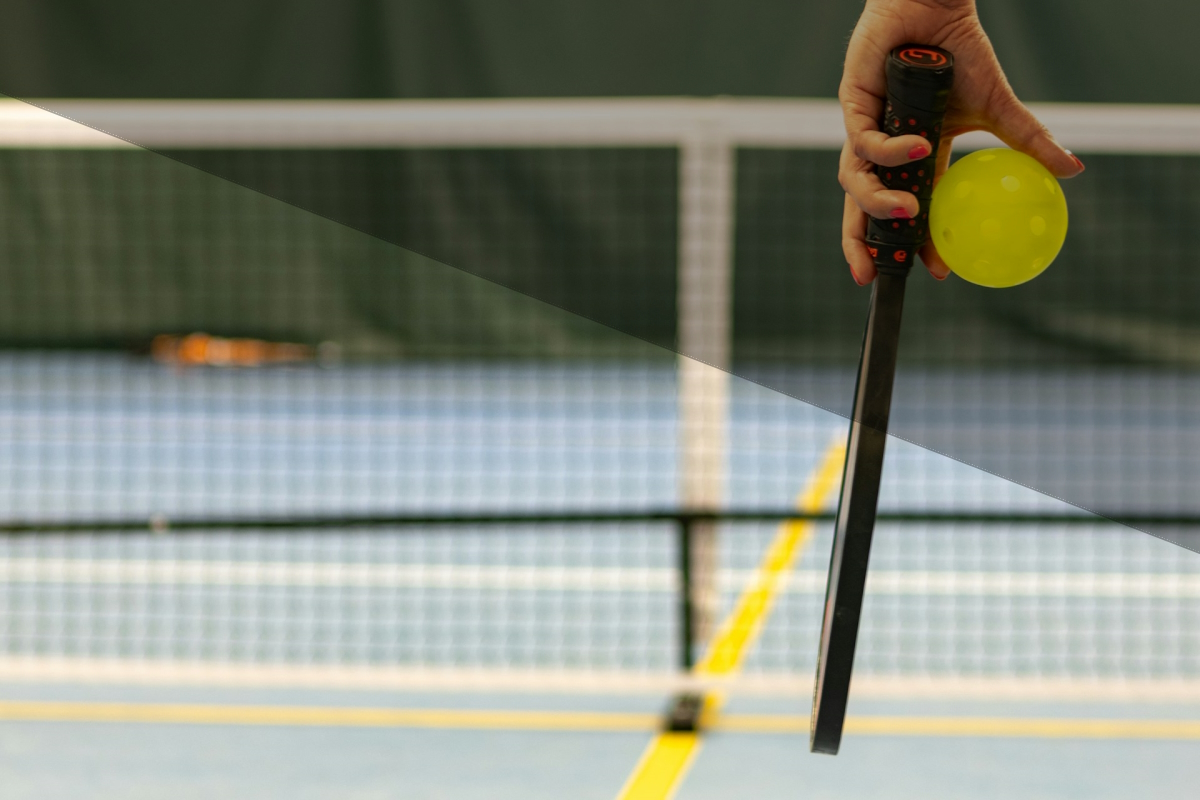
“Ugh, again?” I complained audibly, lacking grace, as I glanced over to gauge how my partner was taking the sudden interruption to the game. My partner’s eyes relayed discomfort with the escalating friction. I took it as a sign that it was up to me to right the game, which was quickly becoming unmoored.
“We’re not redoing the point,” I called across the court. “It was out.”
The woman from the opposing duo yelled back, doubling down on her dispute of the line call.
Here we go, I thought.
This wasn’t the first time this particular player had disputed a line call I made. The last tournament, she argued over another call – different line, different partners, same energy.
For the uninitiated, the official pickleball rule is that it’s the receiving team who calls a ball in or out. That is, it was our call.
I mention this fact so you can understand how absolutely justified I was when I launched into what could be described as a brief verbal match about whether a bright plastic ball with large holes in it landed on or outside of a line painted on the rubberized floor of a children’s school gym during a tournament that had absolutely nothing riding on it with players of skill levels ranging from none to 4.0 paired in a random way that ensured games mostly ended in scores of 11-0.
Of course, while I was justified, she was completely daft.

“The ball was in,” she insisted and, judging from the anger painted on her face, I needed to accept it already.
I can’t possibly let her line call argument slide this time, I told myself as I dug in my heels. I need to teach her a lesson. A lesson for the common good – for the good of all humanity!
I was sucked in, down the emotional slide. Hook, line, and sinker.
A Retreat into Mind
After the game, which took a nosedive after the line call skirmish, I remained indignant. Feeling uncomfortable, I tried to use logic to work my way out of this frustrating emotional state. Why not launch into a mental conversation with myself at the sidelines?
I’m sure you’ve never been there, talking to yourself to sort out your discomfort. Just in case this is all foreign to you, here’s what that can sound like:
Does the call really matter?
Not in most games, which are rarely won by a single point.
But the disagreement can throw off the energy of the match, ruining play, I countered to myself. Plus it’s not friendly or how humans agree this game should be played.
Fine, but you took the bait. Just be the levelheaded one.
I am levelheaded! She’s being rude and must be stopped.
Listen, you’re on a planet in the middle of nowhere spinning around a star with over 8 billion other humans all made of stardust.
But that particular amalgamation of conscious stardust is incorrect. The rules say so.
Why don’t you just go and talk with her. Share a little reasoning and then you two can live in perfect harmony for the rest of your existence together.
Now you’re talking some sense.
I walked over to her to ask about why she often disagrees with line calls (in a fantastically unhelpfully irritated tone). She replied that maybe other players are just kinder than she is about my incorrect calls and circled back to arguing that her call was right, now with added force – because she is going. to. get. through. to. me.
I concede she is right about the first point. But I recognize a sinking ship when I see one and slowly retreat. I back away and return to the safety of my own mind.

Talking with her was a silly idea, I told myself. You were supposed to be the logical one, but reasoning with her was senseless.
You’re the one with the bad attitude. Who asks questions like that?
I’m irritated. Irritated people ask questions like that.
Sigh. It’s true that most of our opponents and you – I, us – accept line calls, even bad ones, preferring frictionless play.
See, I’m frictionless.
And you’ve seen that most of her opponents humor her counter calls, promptly replaying the point or caving.
Well, that’s why she must be stopped. No more permissive bad behavior.
Have you stopped to consider why this friction? Why this friction, again and again?
Ah — a pattern.

Anything Can Be Shadow Work
Our shadow self represents the traits, desires, or emotions we consciously think of as undesirable or unacceptable. It’s often the parts of us we judge or deny. Shadow work involves bringing these unconscious parts of our personality into our awareness so we are less unconsciously directed by them.
“Everything that irritates us about others can lead us to an understanding of ourselves.” – Carl Jung
A shortcut to identifying elements of our shadow self is to observe who really gets under our skin. Then, start exploring why.
Why do I lean into conflict when met with a strong personality?
Why am I fixated on being right when there are rules?
Why am I taking my thoughts as reality and conversing with myself?
Who is aware of these thoughts?
I explore. I accept the foolishness of it all. Because that’s what shadow work requires: uncovering the repressed parts of ourselves – often those parts we wished or pretend don’t exist, like my role in a pickleball game disagreement. I had to accept I was one of those people in that moment.
But it’s not really about the specifics; it’s about recognizing the underlying patterns and resistance. And then accepting, integrating, and learning from it.

Life as Teacher
After a beat, a breath, I’m grateful for this silly pickleball experience. Looking back, the only handhold my ego can grab onto is the comfort of knowing that I’m not the first – or last – to forget how ridiculous a situation is in the moment.
The experience shows me how quickly I slide into patterns of pushing back, when really no response is needed. I saw old patterns of resistance when just a breath would suffice. I wonder, What would it look like if I gave myself time to recenter before acting?
The reality that shadow work points to is that life can be your greatest teacher.
Each moment can help you recognize your reflexive emotional responses, pointing to parts of yourself you reject. By paying attention, exploring the patterns that arise, and integrating what you find, you can use every experience to become a greater being. And maybe, just maybe, stop engaging in line call disputes.
Subscribe to Watering Your Garden
Handcrafted musings, personal event invites, and heartfelt tools guiding you back to the beauty within you? It’s a little something different in your inbox.
Subscribe to the Watering Your Garden newsletter and cultivate an intentional life through each rhythm of the year.
Photo credits all on Unsplash, in order: Aleksander Saks, Uriel Soberanes, Giulia Grani, Martino Pietropoli, and Davino Dove. Thank you.